Review of Philosophy. Art of Art
Keywords:
- Design,
- Façade,
- Beauty,
- Architects
Abstract
Understanding beauty as an expression of life, this research redefines architectural aesthetics through a dynamic, evolutionary design paradigm that integrates biological models, mathematical methods and real-time environmental responsiveness. Drawing inspiration from load-efficient animal structures swallow nests and honeybee hives—the study employs parametric modelling and genetic algorithms to interpret "living" design genes. Macroenvironmental data on site, climate, hydrology and biodiversity establish parameter sets for automated generation of multiple proposals, each evaluated for environmental performance via energy simulation, CFD analyses and quantified ecological services and for aesthetics via proportional deviation, façade variability and psychophysiological metrics (eye tracking, EEG, heart rate variability). Evolutionary operations (crossover, mutation) iteratively refine design populations to balance sustainability and high-dimensional beauty.
To enact this process, adaptive hardware and software systems deploy movable façades and shape-memory alloys that "breathe" in response to real-time temperature, solar radiation and wind data, subtly adjusting wall ratios and proportions (including nuanced deviations from the golden ratio) to optimise comfort and visual harmony. The building's life cycle is framed in three stages growth, maturity, ageing each governed by bespoke aesthetic and control strategies: growth curves inform membrane tension and slab expansion; maturity harnesses timed façade variability and planting systems; ageing celebrates material patina as temporal beauty.
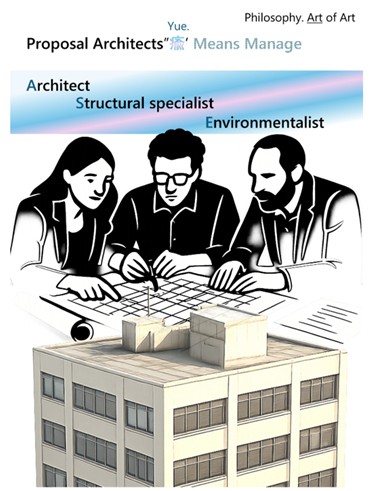
Central to this vision is the establishment of the Architect's "Yue" role, an integrated coordinator combining architectural, structural and environmental expertise to dissolve traditional hierarchies and elevate the rigour of environmental analysis. To sustain innovation, a balance between advanced research and practice is urged: degree attainment becomes obligatory, while politically motivated competitions yield to more meaningful evaluation axes, fostering deep theoretical engagement and creative autonomy.
The Architects "Yue" Organisation Group a collaborative, family-like entity aims to reduce overtime, enhance intellectual productivity and strengthen resilience in cutting-edge design and manufacturing. Anticipated pilot projects across diverse climates will validate universal principles of dynamic aesthetics. An open science platform will disseminate design genes, algorithms and control software to catalyse interdisciplinary co-creation. By positioning environmentalists as central producers and supporting Ph.D. level research in robust manufacturing, this framework aspires to embed "living beauty" in future cities and architecture.
Downloads